


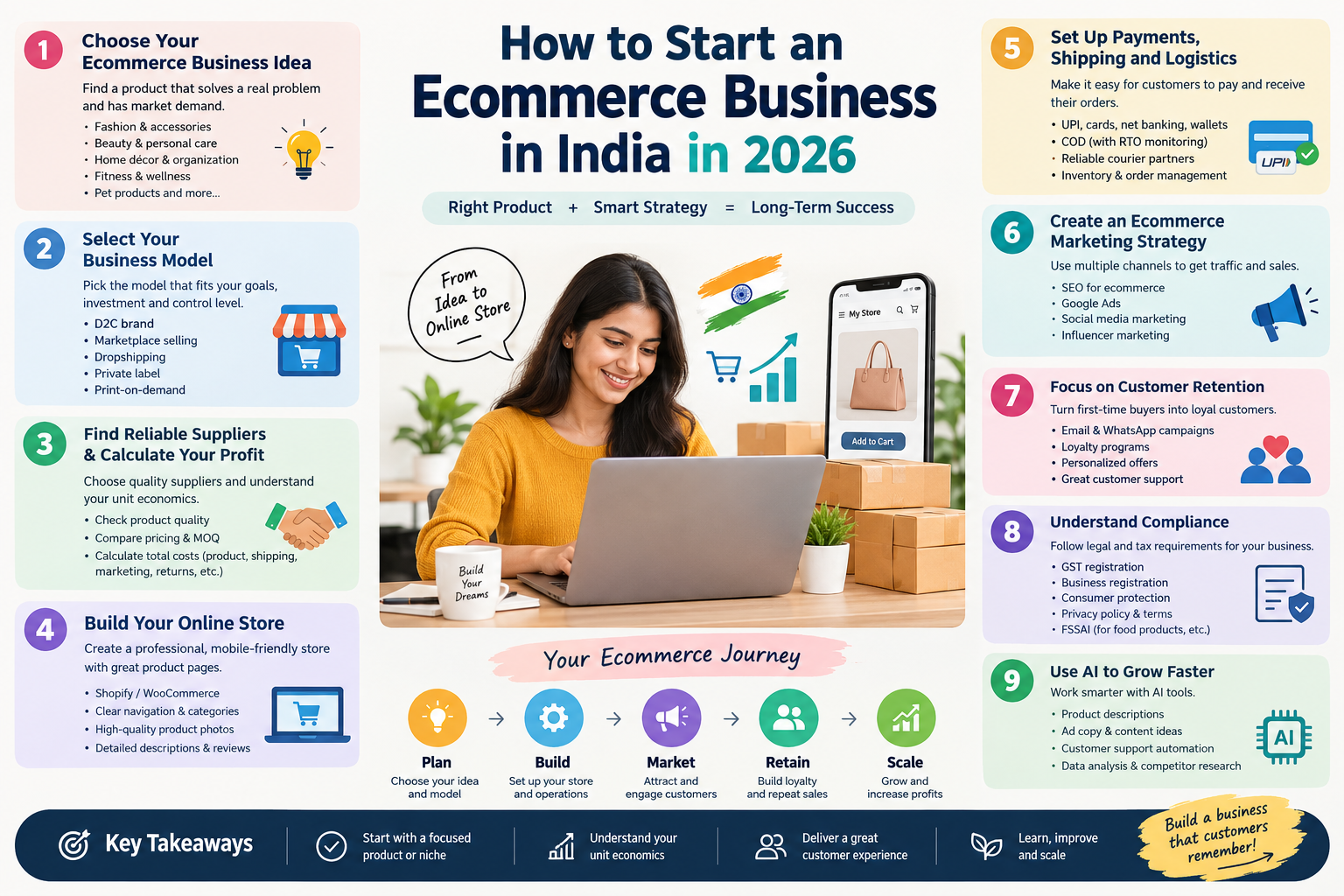
How to Start an Ecommerce Business in India in 2026: A Practical Beginner’s Guide
India’s ecommerce market is no longer limited to large marketplaces and established brands. Today, an individual entrepreneur can discover a product, build an online store, promote it through social media, accept digital payments, and reach customers across the country without opening a physical shop.
That makes Ecommerce business ideas in India particularly attractive in 2026. From niche fashion and beauty products to home essentials, personalized products, digital products, and subscription-based businesses, there are more ways than ever to build an online business.
But launching an ecommerce business is not simply about putting products on a website. You need to choose the right product, understand your customer, calculate your margins, select reliable suppliers, build a trustworthy store, manage logistics, and develop a marketing strategy.
This guide explains how to start an ecommerce business in India in 2026, step by step.

1. Choose the Right Ecommerce Business Idea
The first and arguably most important decision is deciding what you are going to sell.
A common beginner mistake is choosing a product simply because it looks popular on Instagram or another marketplace. Popularity alone does not guarantee profitability. A good ecommerce product should solve a specific problem, have consistent demand, offer enough room for profit, and be practical to source and deliver.
Some promising Ecommerce business ideas in India include:
- Fashion and accessories
- Beauty and personal-care products
- Home décor and organization products
- Fitness and lifestyle products
- Pet products
- Personalized gifts
- Handmade products
- Sustainable products
- Digital products
- Print-on-demand products
- Specialty food products
- Educational products and resources
Instead of asking, “What product is trending?”, ask:
“Who is the customer, what problem do they have, and why would they buy this particular product from me?”
For example, instead of creating a general fashion store, you could focus on affordable workwear for young professionals, sustainable clothing, or customized apparel.
This creates a more specific target audience and makes your branding and marketing much easier.
Validate Product Demand Before Investing
Before purchasing inventory, perform basic market demand research.
Look at:
- Google search trends
- Marketplace reviews
- Competitor products
- Social-media discussions
- Customer complaints
- Product ratings
- Search suggestions
- Pricing across competing stores
Read negative reviews carefully. They often reveal opportunities.
If customers repeatedly complain that a product is poorly packaged, uncomfortable, difficult to use, or too expensive, you may have discovered an opportunity to create a better alternative.
This process is called product validation. The goal is to find evidence that people actually want the product before putting significant money into inventory.
2. Select Your Ecommerce Business Model
Once you have a product idea, decide how you will sell it.
Your ecommerce business model affects your investment, margins, operations, and level of control.
D2C Ecommerce
A D2C (Direct-to-Consumer) brand sells directly to customers through its own website or digital channels.
For example:
Manufacturer → Your Brand → Customer
The major advantage is control. You control your branding, customer experience, product presentation, and customer data.
However, you are also responsible for attracting customers, handling technology, managing support, and building trust.
Marketplace Selling
You can also sell through established marketplaces such as Amazon, Flipkart, or other ecommerce platforms.
The advantage is access to an existing customer base.
The disadvantage is greater competition and marketplace fees, policies, and dependence on the platform.
Dropshipping
With dropshipping, you don’t necessarily keep inventory yourself. When a customer places an order, a supplier fulfills it.
This can reduce initial inventory investment, but you have less control over product quality, packaging, fulfillment speed, and customer experience.
Therefore, always research your supplier carefully before using this model.
Private Label
A private-label business involves sourcing an existing product and selling it under your own brand.
For example, a manufacturer produces a skincare product, while you develop the branding, packaging, positioning, and customer experience.
Private labeling can be attractive because it allows you to build a brand rather than simply resell another company’s product.
Digital Products
Not every ecommerce business needs physical inventory.
You could sell:
- Templates
- Design assets
- Educational resources
- Ebooks
- Digital planners
- Business resources
- Online courses
The biggest advantage is that digital products do not require traditional warehousing or physical shipping.
Print-on-Demand
With print-on-demand, products such as T-shirts, mugs, posters, or notebooks are produced after customers place orders.
This can be useful for testing creative ideas without purchasing large quantities of inventory upfront.
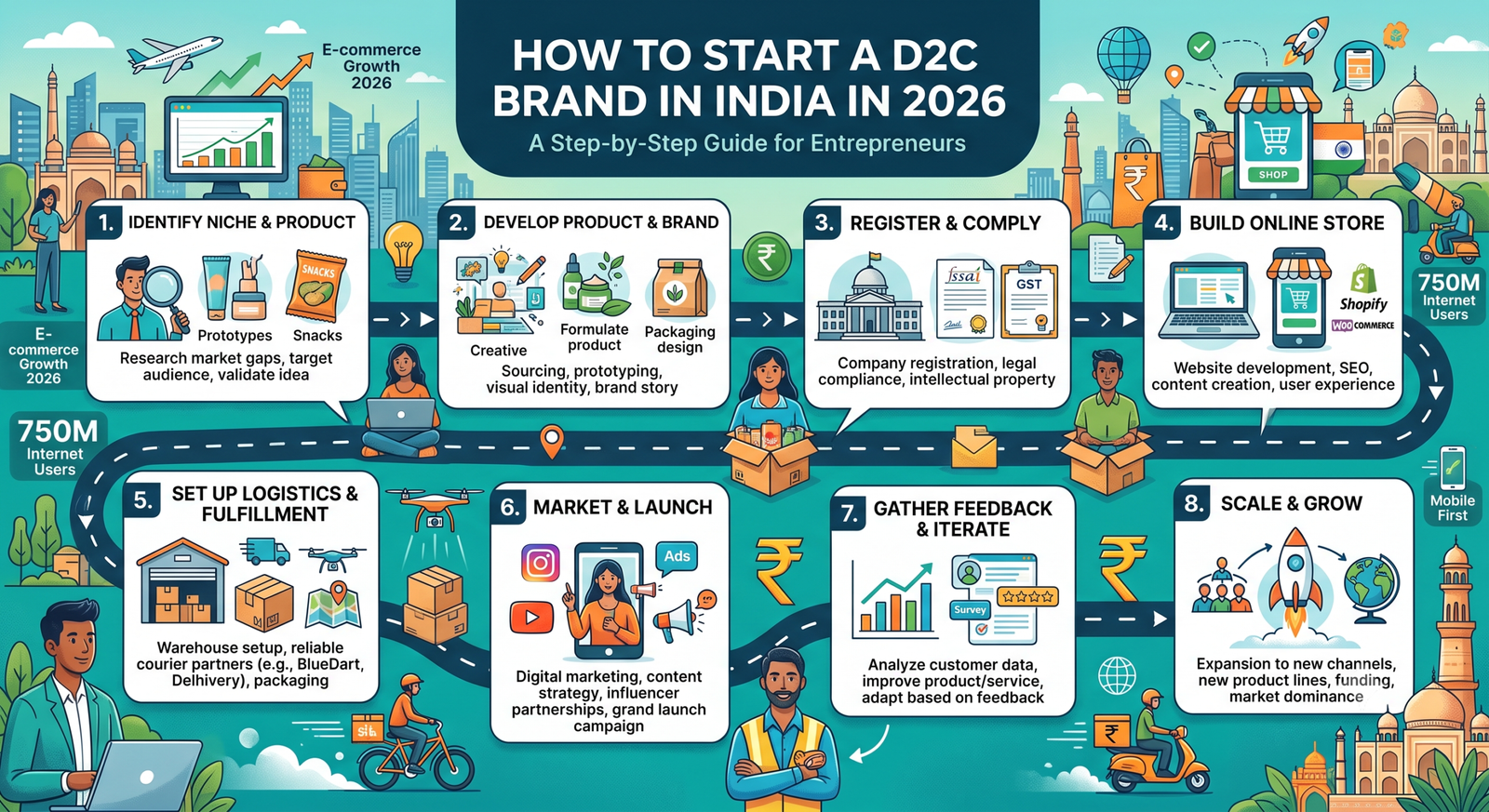
3. Build Your Store and Set Up the Business
After selecting your business model, the next step is creating your ecommerce infrastructure.
You can build an own ecommerce store using platforms such as Shopify or WooCommerce, or start with an ecommerce marketplace.
Shopify vs WooCommerce
Shopify is popular among beginners because it provides hosting, ecommerce functionality, themes, payment integrations, and other features in one ecosystem.
WooCommerce works with WordPress and provides greater flexibility and control, although it can require more technical management.
The best platform depends on your budget, technical skills, product catalog, and long-term goals.
Create a Professional Product Catalog
Your product catalog should make it easy for customers to understand what they are buying.
Each product page should ideally include:
- Clear product name
- High-quality product photography
- Key features
- Benefits
- Specifications
- Available sizes or variants
- Pricing
- Shipping information
- Return information
- Customer reviews
- Frequently asked questions
Don’t simply copy a supplier’s description.
Write product content for your actual customer.
For example, instead of saying:
“Premium cotton T-shirt with comfortable construction.”
You could explain:
“Designed for everyday wear, this lightweight cotton T-shirt is suitable for college, casual outings, and weekend travel.”
The second version helps the customer visualize how the product fits into their life.
Product Photography Matters
Your product photography can significantly influence purchase decisions.
Use a combination of:
- White-background product images
- Multiple product angles
- Close-up detail shots
- Size or scale references
- Lifestyle photography
- Product-in-use images
For online shoppers, these images replace much of the physical examination they would normally perform in a store.
4. Set Up Payments, Inventory and Ecommerce Logistics
A beautiful website won’t help if customers cannot pay easily or receive their orders reliably.
Payment Gateway
Set up a reliable payment gateway that supports commonly used payment methods.
In India, customers are increasingly comfortable with UPI, cards, net banking, and other digital payment options.
Offering multiple payment methods can reduce unnecessary friction during checkout.
UPI Payments
UPI payments are particularly important for Indian ecommerce businesses because they allow customers to complete transactions quickly from their smartphones.
Depending on your business model and payment setup, you may also offer Cash on Delivery.
Cash on Delivery
Cash on Delivery (COD) can increase conversion among customers who are hesitant to make prepaid purchases.
However, COD can create additional operational challenges, particularly failed deliveries and Return-to-Origin (RTO) orders.
For this reason, businesses should monitor:
- COD percentage
- Failed delivery rate
- RTO rate
- Prepaid conversion
- Average order value
Inventory Management
Good inventory management prevents two common problems:
Overstocking: Too much money is tied up in unsold products.
Understocking: Popular products become unavailable and potential sales are lost.
Start with manageable inventory when possible. Once you understand which products sell consistently, you can increase purchasing volume.
Ecommerce Logistics
Ecommerce logistics includes everything involved in getting the product from your warehouse or supplier to the customer.
This includes:
- Packaging
- Order processing
- Courier selection
- Shipment tracking
- Delivery
- Returns
- Exchanges
Your choice of courier partners can directly affect customer satisfaction.
Don’t select a logistics provider only because it offers the lowest price. Compare delivery coverage, tracking, pickup reliability, COD support, return handling, and customer service.
Shipping Costs
Shipping costs can quietly destroy an ecommerce business’s margins.
Before setting your selling price, calculate:
Product Cost + Packaging + Shipping + Payment Fees + Marketing Cost + Returns = Actual Cost
Then compare that cost with your selling price.
This is where unit economics becomes important.
For example, if you sell a product for ₹999 but your combined product, shipping, packaging, payment, advertising, and return costs total ₹850, your apparent ₹999 selling price doesn’t mean you have a healthy ₹149 profit.
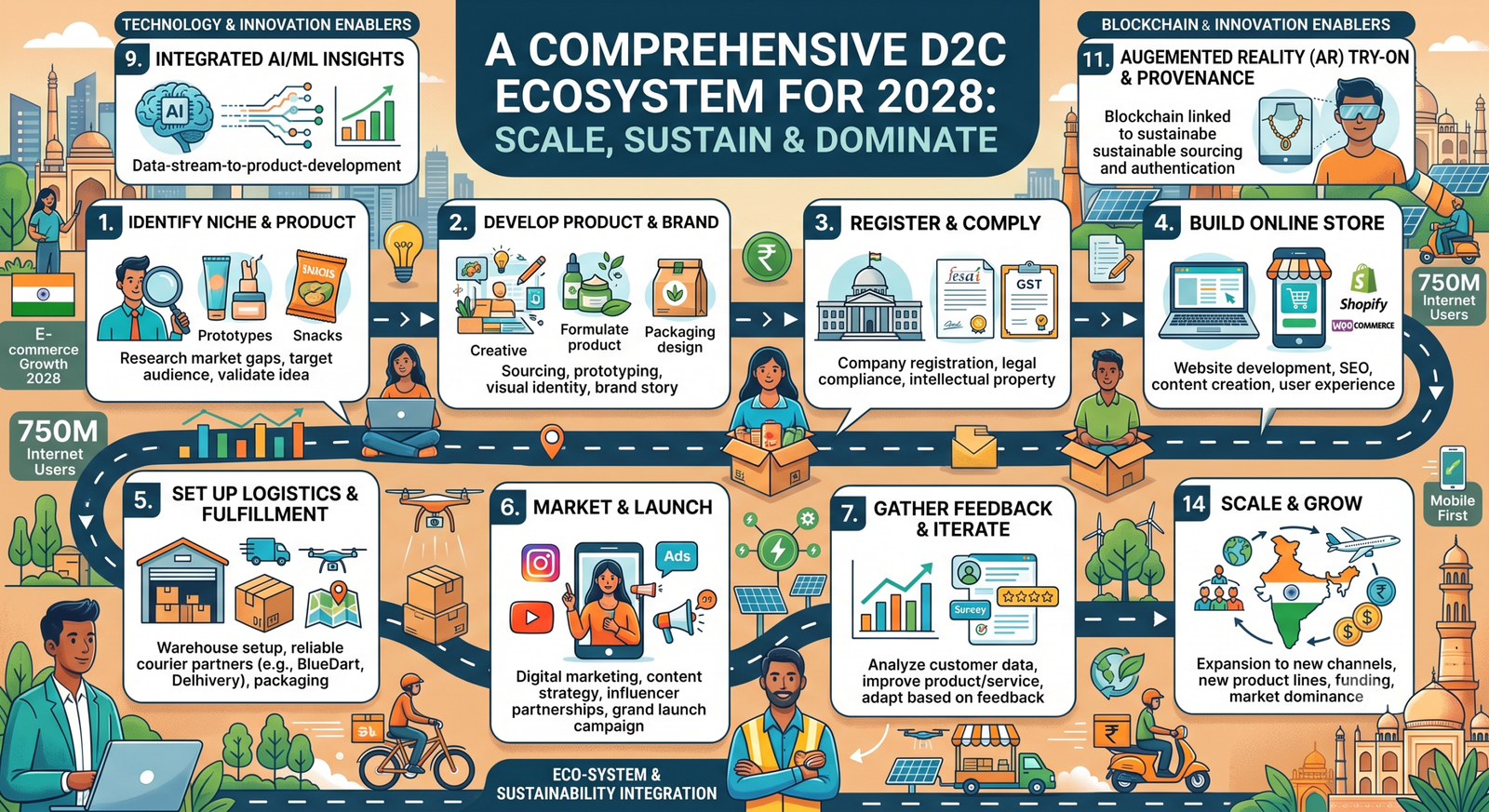
5. Build Your Marketing and Customer Growth Strategy
Once your store is ready, the next challenge is getting customers.
This is where ecommerce digital marketing becomes essential.
Don’t depend on just one channel.
SEO for Ecommerce
SEO for ecommerce helps your products and category pages appear when potential customers search on Google.
Focus on:
- Product keywords
- Category keywords
- Long-tail searches
- Product descriptions
- Internal linking
- Image optimization
- Structured data
- Helpful content
- Customer reviews
For example, instead of targeting only “running shoes,” you could create content around specific searches such as:
“best running shoes for beginners”
“lightweight running shoes for daily running”
“how to choose running shoes”
These searches can attract people at different stages of the buying journey.
Google Ads
Google Ads can help you reach customers who are already searching for relevant products.
Paid advertising can generate traffic faster than SEO, but you need to monitor your numbers carefully.
Track:
- Cost per click
- Conversion rate
- Customer acquisition cost
- Average order value
- Return on ad spend
Never assume that increasing ad spending automatically increases profit.
Social Media Marketing
Social media marketing can help ecommerce brands create awareness and build a community.
Instagram, YouTube, Facebook, and other platforms can be used for:
- Product demonstrations
- Tutorials
- Customer testimonials
- Behind-the-scenes content
- Educational content
- Short-form videos
- User-generated content
The goal shouldn’t always be to sell immediately.
Show customers how your product solves a problem or fits into their lifestyle.
Influencer Marketing
Influencer marketing can be effective when the creator’s audience matches your target customer.
You don’t necessarily need a celebrity.
A smaller creator with a highly relevant and engaged audience can sometimes be more useful than a large account with an unrelated audience.
For example, a fitness-product brand may benefit more from a fitness creator with a focused audience than from a general entertainment influencer.
Customer Retention
Getting your first customer is only one part of ecommerce.
Customer retention can be even more valuable because an existing customer already knows your brand.
Use:
- Email marketing
- WhatsApp communication
- Loyalty programs
- Personalized offers
- Product recommendations
- Reorder reminders
- Customer support
The goal is to turn a one-time transaction into a long-term relationship.
Repeat purchases can significantly improve the economics of an ecommerce business because you don’t necessarily need to spend the same amount acquiring every future order.
Understanding Ecommerce Unit Economics
One of the biggest differences between a hobby store and a sustainable ecommerce business is understanding the numbers.
Your ecommerce unit economics should account for the actual cost of selling one order.
Consider:
Selling Price
minus
Product Cost
minus
Packaging
minus
Shipping
minus
Payment Processing
minus
Customer Acquisition Cost
minus
Expected Return/RTO Cost
equals
Contribution Margin
This calculation gives you a much more realistic picture than simply looking at the difference between product cost and selling price.
For example, suppose you sell a product for ₹1,500.
Your approximate costs might be:
- Product: ₹500
- Packaging: ₹50
- Shipping: ₹100
- Payment: ₹30
- Advertising: ₹300
- Expected returns/RTO: ₹100
Your remaining contribution is roughly ₹420.
This is why pricing, advertising efficiency, logistics, and customer retention need to be considered together.
Ecommerce Returns and Customer Experience
Ecommerce returns are another major consideration, particularly in categories such as fashion.
Common reasons include:
- Incorrect size
- Product expectations not matching reality
- Damaged product
- Wrong product
- Poor quality
- Customer changing their mind
You can reduce returns by providing accurate product descriptions, sizing information, photographs, videos, specifications, and clear policies.
At the same time, don’t make returns unnecessarily difficult. A transparent return policy can increase customer confidence before purchase.
Ecommerce Compliance in India
Before launching, understand the legal and tax requirements that apply to your particular business.
Depending on your products and business structure, you may need to consider:
- Business registration
- GST registration
- Tax compliance
- Invoicing
- Consumer protection requirements
- Privacy policies
- Terms and conditions
- Return and refund policies
- Product-specific regulations
Certain categories may have additional requirements. For example, food businesses may need FSSAI registration or licensing depending on their activities.
Because regulations can change and requirements depend on the business structure and products you sell, verify the latest requirements through official government sources or a qualified professional before launching.
Conclusion: How to Start an Ecommerce Business in India in 2026
Starting an ecommerce business in India in 2026 is more accessible than ever, but accessibility doesn’t mean success is automatic.
The strongest ecommerce businesses usually begin with a clear customer problem, a focused product, healthy unit economics, reliable operations, and consistent marketing.
You don’t need 100 products on day one. You don’t need an enormous warehouse. And you don’t necessarily need a huge advertising budget.
Start with one strong product or a focused category.
Validate demand.
Build a trustworthy own ecommerce store or choose the right marketplace.
Improve your product catalog and customer experience.
Test SEO for ecommerce, social media, Google Ads, and influencer marketing.
Track your numbers.
Listen to customers.
Then scale what works.
If you’re exploring Ecommerce business ideas in India, don’t focus only on what is trending today. Look for a product category where you can build a recognizable brand, solve a real customer problem, and create repeat purchases.
The goal isn’t simply to make your first online sale. The goal is to build an ecommerce business that customers remember, trust, and return to.